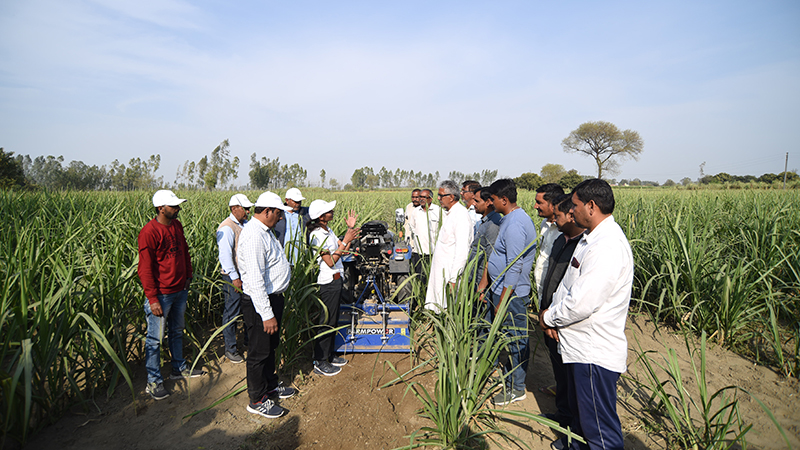
Although farmers are central to the existence of agribusinesses, more often than not, the systems that secure agricultural produce focus on short-term procurement benefits rather than enhancing the long-term capability and resilience of farming communities. This structural paradox, over time, affects the quality, reliability, and sustainability of the agricultural supply chain, impacting outcomes at both the farm and enterprise level.
At Dhampur Bio Organics (DBO), farmer upliftment is an integral part of our guiding philosophy, forming the backbone of our value chain. Our comprehensive farmer outreach initiatives, ranging from soil health and water management programmes to digital enablement and knowledge sharing, reflect a clear understanding that investing in farmer capability is not just a corporate social responsibility; it is a fundamental business strategy.
By strengthening the foundation of our supply chain, we are not only securing today’s production but building the resilience required for long-term, sustainable growth.
Farmers as Partners, Not Just Suppliers
At DBO, we engage with over 160,000 farmers across our operating regions in Western Uttar Pradesh and Uttarakhand. These are not transactional relationships built on seasonal procurement cycles, they are partnerships grounded in mutual respect, prosperity, engagement, and shared responsibility for sustainable agricultural practices.
This distinction matters. In the sugar and bio-energy sector, the quality and consistency of sugarcane directly affect production efficiency, recovery rates, energy consumption, manufacturing costs, and regulatory compliance. Farm-level variability introduces supply security risks, particularly in regions exposed to climate stress and water scarcity. Our farmers outreach programme responds to these realities through sustained, multi-year investment in agricultural capability across our supply base.
The scale of this commitment is measurable. We achieve 75-100 percent farmer coverage in our catchment areas, compared to an industry average of roughly 60 percent. Each year, we conduct more than 1,500 farmer meetings and deliver approximately 900 hours of technical training. These efforts are not seasonal or episodic; they form part of our daily operational execution.
Strengthening Farmer Capability Through Knowledge Sharing
Knowledge sharing sits at the heart of our farmers outreach model. We believe that informed farmers make better decisions, decisions that improve yields, enhance sustainability, and strengthen supply chain reliability.
Our training programmes cover practical, field-relevant topics: improved cultivation techniques, integrated pest management, water-use optimization, soil health management, and disease control. These sessions are led by agronomic experts and supported by collaboration with leading agricultural scientists, including Dr. Bakshi Ram, known for developing the CO-0238 sugarcane variety that accounts for nearly 70 percent of North India’s cultivated area.
Beyond classroom-style training, we’ve built structured systems for knowledge multiplication. Our Tissue Culture Lab at the Meerganj facility enables rapid propagation of superior varieties. This feeds into a three-tier seed multiplication system that begins at factory research farms, extends through the Self-Help Groups (SHGs), and reaches progressive farmers for wider dissemination. The result is faster variety replacement and stronger on-farm capability.
Structured Framework for Consistent Farmer Engagement
Effective outreach requires more than good intentions; it demands structured execution. To ensure consistency, we’ve built a dedicated field organization with clear accountability at every level.
Strategic oversight is provided by a Chief General Manager, supported by Area Managers and Zonal In-charges responsible for regional coordination and local implementation. On the ground, our Field Supervisors maintain daily contact with farmers, taking expertise directly to the fields rather than waiting for issues to emerge.
In parallel, we organize more than 1,500 village-level gatherings, locally known as “Goshtis”, each year. These forums function as spaces for collective learning, experience sharing, and peer validation. They strengthen trust while accelerating the adoption of improved practices, creating ripple effects across farming communities.
Extending Reach Through Digital Tools
Technology has become a force multiplier in our farmers outreach efforts. We’ve integrated digital tools not to replace personal relationships, but to extend our reach and improve the quality of our engagement.
For our field teams, the DBO Cane Field Force App enables real-time data capture, GPS-based activity mapping, and automated reporting. It replaces paper-based systems with actionable analytics, allowing supervisors to track engagement patterns, identify gaps, and respond proactively to emerging challenges.
For farmers, the Krishak Mitra App provides video-based training, crop advisories, and financial planning guidance in regional languages. This ensures continuous access to information while allowing field staff to focus on complex, high-value interventions. WhatsApp groups and our official YouTube channel further extend communication reach, creating a digitally enabled last mile that connects farmers to expertise, markets, and each other.
Technology Adoption: Making Best Practices Feasible
Farmers outreach succeeds when recommended practices are economically and operationally viable. We’ve invested in technologies that make this possible.
Since 2022, we’ve deployed drone-based fertilizer and pesticide applications, delivering roughly 30 percent reduction in chemical usage, improved application precision, and lower health and environmental risk. We’ve also invested in modern land-preparation equipment, making recommended agronomic practices feasible rather than theoretical.
A particularly telling example is pest management. Traditional light traps were effective but too expensive for widespread adoption. We designed simplified versions at one-tenth the conventional cost and distributed more than 1,000 units at subsidized rates. The lesson is consistent across our programme: technology must be adapted to local economics to achieve scale.
Sustainability in Practice: Water, Soil, and Certification
Sustainable agriculture is not an abstract commitment at DBO; it is embedded in our farmers outreach activities.
Sugarcane’s water requirement, between 2,000 and 2,500 mm annually, makes efficiency critical. We promote skip-furrow irrigation, space planting, critical-stage watering, mulching, and intercropping, tailoring approaches to local water systems. These measures have reduced water intensity per tonne of cane crushed, lowering operational risk in water-stressed regions.
Soil health initiatives focus on integrated nutrient management. By composting press mud and blending it with potash-rich spent-wash ash, we convert factory by-products into subsidized organic fertilizers. Vermicomposting pilots and crop rotation guidance further support long-term productivity while reducing chemical dependence.
In December 2024, we achieved Bonsucro certification for our Asmoli unit, covering 800 farmers cultivating 1,294 hectares, with 4,800 additional farmers assessed for future certification. Bonsucro is a globally recognized standard encompassing environmental protection, labor rights, and responsible land management. For us, certification delivers tangible business benefits: access to sustainability-conscious markets, differentiation in a commodity sector, and reduced exposure to evolving ESG regulations. For farmers, it strengthens farm management practices and opens pathways to premium markets.
Economic Viability: The Cornerstone of Partnership
Our approach recognizes that sustainability succeeds only when it is economically viable for farmers. We manage input costs through subsidies and shared equipment access, while revenues improve through higher yields, better recovery, disease resistance, and certification-linked market access. Timely cane payments and price transparency underpin trust and long-term engagement.
The commercial rationale is clear: better-informed, better-equipped farmers produce higher-quality cane with more predictable recovery rates. This directly influences our manufacturing efficiency, cost control, and ability to meet evolving market and regulatory requirements.
Measured Impact, Long-Term Value
The outcomes of our farmers outreach programme are both quantifiable and strategic:
- Engagement with 160,000+ farmers across our operating regions
- 75–100 percent catchment coverage, well above industry benchmarks
- 800 Bonsucro-certified farmers
- Deployment of 1,000+ precision pest-control devices
- Widespread adoption of digital platforms and drone technologies
- Participation in national research programmes for climate-resilient varieties
These translate directly into improved supply security, quality consistency, and risk mitigation, critical factors for long-term business performance in a sector exposed to climate variability, policy shifts, and evolving sustainability expectations.
Looking Ahead: Partnership as Strategy
The past year has tested the sugar and bio-energy sector with unpredictable weather, pest pressures, and policy challenges. Through it all, we remained focused on what matters most: supporting our farmers, strengthening our operations, and building sustainable value for our communities and stakeholders. Our farmers outreach programmes are not peripheral activities; they are central to our business model. By investing consistently in farmer capability, sustainability practices, and digital infrastructure, we’ve built a resilient supply network that supports business performance while strengthening rural livelihoods.